Subterranean termite management in Collin County demands perimeter soil integration tailored directly to regional architectural methods. Homes constructed across neighborhoods like Willow Bend, Kings Ridge, and…
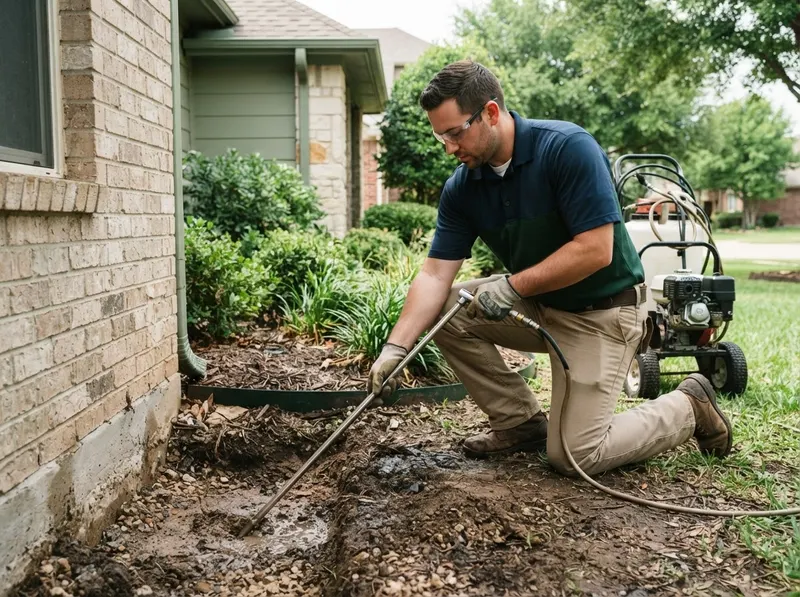
Subterranean termite management in Collin County demands perimeter soil integration tailored directly to regional architectural methods. Homes constructed across neighborhoods like Willow Bend, Kings Ridge, and Deerfield routinely utilize monolithic concrete slab foundations resting on expansive Houston Black clay. During hot Texas summers, clay soils pull away from concrete foundations, creating subterranean pathways through plumbing penetrations and footing fissures. Liquid soil treatment establishes an undetectable liquid zone directly where eastern subterranean termites enter, allowing the active ingredient to transfer naturally across the foraging colony rather than relying on topsoil surface applications.
A complete perimeter installation involves hand-excavating a 6-inch by 6-inch trench adjacent to exterior foundation walls, applying termiticide precisely into the soil matrix, and backfilling the displaced earth. For attached garages, covered lanais, and extended concrete patios, common along residences near Lakeside on Preston and Avignon Windhaven, technicians drill 1/2-inch holes through the flatwork spaced roughly 12 inches apart to treat the underlying substrate before sealing the drill sites with matching masonry plugs. The entire process focuses on deep sub-surface placement, keeping treatment materials bound securely to soil particles beneath root layers so backyard areas remain comfortable for children and household pets immediately after the work concludes.
Selecting a continuous soil application differs significantly from ongoing termite bait station grids. Bait systems use monitoring cartridges inserted flush with the lawn surface, which rely on foraging workers finding the stations over several months, accompanied by recurring quarterly inspection agreements. Liquid soil barriers provide immediate active control along the entire foundation interface upon application without requiring multi-year service contract lock-ins. The trade-off lies in upfront mechanical preparation: homes with heavy stone masonry or wraparound flagstone walks require precise diamond drilling through hardscapes, whereas homes with standard perimeter mulched beds in Russell Creek, Whiffletree, or Forest Creek Estates allow for pure soil trenching with minimal property disturbance.
Structural longevity across neighborhoods near the Arbor Hills Nature Preserve, Oak Point Park, and the Heritage Farmstead Museum relies on keeping treated soil undisturbed. Homeowners performing landscaping renovations, re-edging garden beds, or adding drainage swales after treatment must avoid digging within 6 inches of the concrete stem wall to maintain perimeter continuity. Foundation movement caused by North Texas seasonal drought cycles can occasionally separate treated soil planes, which is why treating along the total structural perimeter prevents colony shifts from natural garden beds into indoor sill plates.
Every job gets a firm, written price after a free on-site visit.
Tell us about your subterranean termite soil treatment job in Plano and we'll send a clear, written quote, usually the same day.
 Blue Heron Pest Control