Roof rat attic exclusion addresses the arboreal nesting behavior of Rattus rattus, a species that travels through tree canopies and utility drops to enter upper building envelopes. In Plano neighborhoods like Willow…
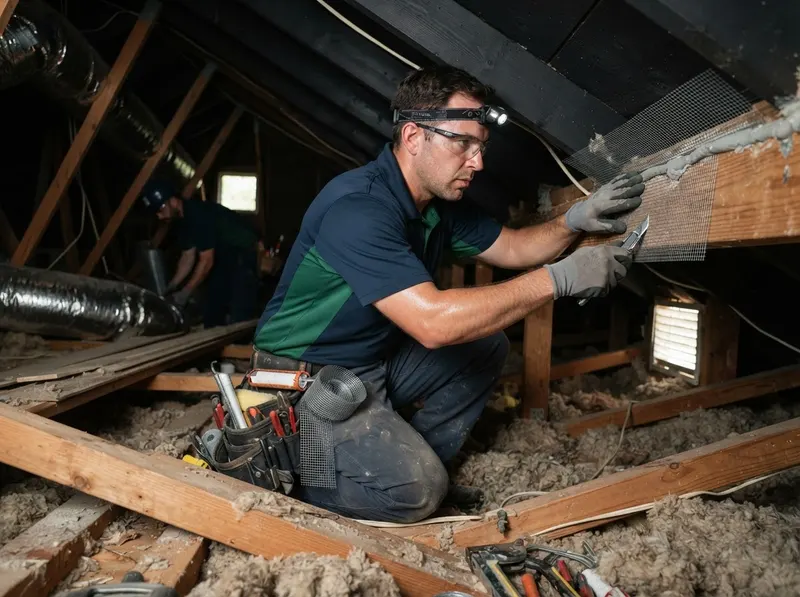
Roof rat attic exclusion addresses the arboreal nesting behavior of Rattus rattus, a species that travels through tree canopies and utility drops to enter upper building envelopes. In Plano neighborhoods like Willow Bend, Kings Ridge, and Deerfield, established live oaks and Bradford pears frequently contact roof decks, granting rodents direct access to architectural vulnerabilities. Unlike standard pest management that dispenses toxic anticoagulant rodenticides, which introduce secondary poisoning risks to neighborhood pets and leave rodents to expire inside enclosed sheetrock walls, exclusion uses structural engineering. Technicians secure fascia gaps, ridge vents, eave corners, and roof returns using 16-gauge galvanized steel hardware cloth secured with exterior-grade fasteners. This physical barrier denies re-entry while spring-loaded, mechanical traps inside the attic capture remaining individuals without aerosolizing toxic compounds near bedroom ceilings.
The remediation stage targets contamination hazards left by established colonies. In homes across Lakeside on Preston, Avignon Windhaven, and Whiffletree, roof rats deposit urine, fecal pellets, and greasy sebum along attic joists, which act as biological scent trails for outdoor rodents. Remediation technicians extract contaminated loose-fill insulation, apply broad-spectrum microbial misting to neutralize zoonotic bacteria, and install non-toxic borate cellulose insulation. A structural trade-off exists between spot patching and full perimeter exclusion: sealing only an active entry hole costs less initially but routinely redirects rodents to adjacent unreinforced dormers within 14 days, whereas full-perimeter defense permanently secures every gap larger than one-quarter inch across the entire roofline.
Properties near dense creek corridors, such as Forest Creek Estates along Russell Creek, Briarwood, and Pitman Creek North, face constant environmental pressure from native rodent populations moving along riparian zones. Roof rat exclusion preserves structural integrity without requiring ongoing chemical subscription contracts. Because roof rat teeth possess a 5.5 Mohs hardness rating capable of gnawing through vinyl, wood, aluminum, and electrical wiring, exclusion relies strictly on heavy steel barriers and industrial-grade siliconized caulking. Initial inspections confirm structural measurements, allowing homeowners to receive a precise, written scope of work based on roofline linear footage, entry complexity, and attic clearance.
Every job gets a firm, written price after a free on-site visit.
Tell us about your roof rat attic exclusion and remediation job in Plano and we'll send a clear, written quote, usually the same day.
 Blue Heron Pest Control